Whole Wheat Pastry Flour Crêpes

Last Updated October 5, 2017 · First Published October 10, 2013

 Cordon Bleu-trained chef Alison Ashton is the operations director for Nourish Network, a website devoted to empowering your evolution from processed food to real food. You can connect with Nourish Network on Facebook, Twitter, Pinterest, and Google Plus.
This is a guest post for October Unprocessed. If this is your first time here, welcome! …and it’s not too late to join in!
I’m sure October Unprocessed comes with all kinds of confessions and tales of reform.
Here’s mine: I’ve got an intense sweet tooth. I’ve never met a baked good I didn’t want to gobble. And when I got out of culinary school, I did a stint in a pastry kitchen, where I went through bins of processed flour and sugar to turn out countless pies, cakes and cookies.
So getting used to using whole-wheat flour in baked goods was a little bumpy at first. Someone would hand me a cookie or muffin or other goodie made with the regular whole-wheat flour, and it was good for me, sure, but not very … good. Truthfully, it was like eating a hockey puck. Heavy. Dense. Wheaty.
I knew I should be using whole-wheat flour in my baked goods. But I didn’t really want to.
That is, until I found my secret weapon: whole-wheat pastry flour. Well it’s not such a secret now, because you can find it in any natural foods store, online and even at many supermarkets. And that’s great news for anyone who wants to bake unprocessed treats. Here’s why:
Regular whole-wheat flour is made with hard white or red wheat. It’s got lots of gluten, which is great when you’re making a hearty loaf of whole-grain bread. (Here’s the scoop on white whole wheat flour.) But it’s a little much when you’re making something more delicate, like cookies or muffins.
Whole-wheat pastry flour is milled from soft white wheat, so it has less protein than regular whole-wheat flour. Less protein means less gluten and more tender baked goods. And no more hockey pucks.
So give this glorious stuff a try in some of your favorite baked goods. Just go ahead and replace that all-purpose flour with the same amount of whole-wheat pastry flour.
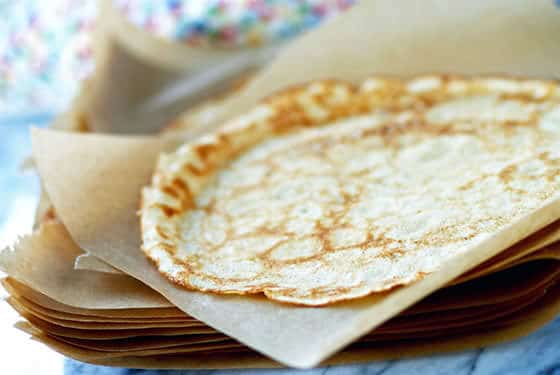
And give it a spin in these delicate traditional French crepes, which are delicious with sweet or savory fillings.
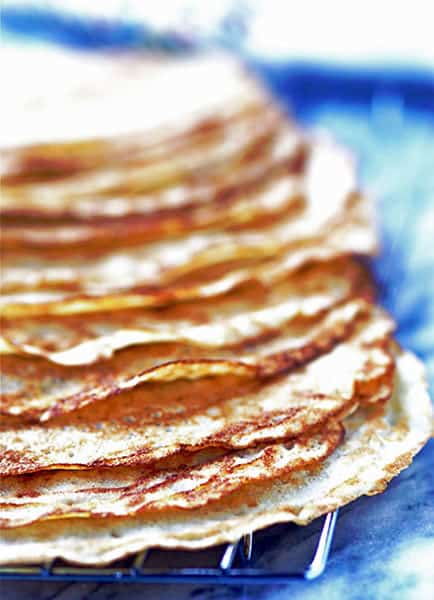
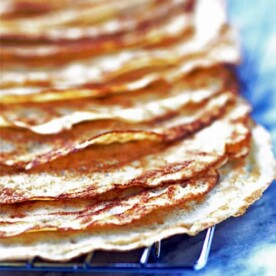
Whole Wheat Pastry Flour Crepes
Ingredients
- 1 cup whole wheat pastry flour, such as Bob's Red Mill
- 1/2 teaspoon sea salt
- 3 large eggs, lightly beaten
- 1 cup milk
- 1-1/2 tablespoons butter, or DIY Ghee
- additional melted butter, for cooking the crepes
Instructions
- Whisk together the flour and salt in a medium bowl. Whisk in the eggs until well-combined. Gradually add the milk, whisking until the batter is thoroughly combined and the consistency of heavy cream. Strain the batter through a fine-mesh sieve (to remove any little lumps) into another medium bowl.
- Heat 1-1/2 tablespoons butter in a stainless-steel skillet or small saucepan; cook until butter until is browned (if you use DIY Ghee, just melt it and you're good to go). Keep an eye on it so it doesn’t burn. Whisk the browned butter into the batter. Cover, and let stand at least 30 minutes and up to 2 hours.
- Heat a 10-inch nonstick skillet over medium heat. Brush the surface of pan with melted butter. Use a small ladle to add 2 to 4 tablespoons batter to pan (just enough to coat the bottom of the pan with a thin layer of batter), swirling the pan to coat. Cook about 2 minutes, or until the edges are lightly browned and the bottom is golden (use a rubber spatula to lift the crepe and peek at the bottom). Flip the crepe; cook another minute or so until the other side is golden. (Don’t worry if the first crepe isn't perfect -- French cooks call that the “sacrifice.”) Transfer crepe to a wire rack. Repeat with oil and remaining batter. Keep the crepes warm in a low oven to serve immediately, or cool completely and refrigerate or freeze.
Notes
Nutrition


















Hi! Thank you for your recipe! I’ve just made the batter and realised it wasn’t mentioned if it should stand in the fridge or at room temperature… Can you, please, clarify that? Doaes it make any difference?
I know you may not answer in time for me but I’ll check your answer to know for the next time.
Thank you in advance!
Yummy! I am so used to the flavor of whole wheat items that plain bread and such taste plain and ordinary!
A great kind of whole “wheat” flour to use is spelt. It’s very soft and fluffy and wonderful in baked goods! It’s become my flour of choice.
Oh, yeah, spelt flour is awesome stuff! I love it for bread!
Hi, Irvin:
Thanks for the correction! Another brand (and they’re not the only one), who shall remain nameless, does label their whole wheat pastry flour as “whole wheat pastry flour/graham flour.” I think this is a common misconception.
So, folks, as Irvin points out, if you’re looking for that soft, tender crumb, stick with whole wheat pastry flour!
Although, hmmm, this really makes me want to give true graham flour a try in bread. Anyone have a favorite graham flour recipe to share? Homemade graham crackers?
I have a homemade graham cracker recipe that actually uses a number of whole grain flours in it, including teff, white whole wheat and buckwheat. It’s sweetened with honey and sucanat and would be suitable for October Unprocessed. http://www.eatthelove.com/2011/04/guilt-free-graham-crackers-whole-grain-unprocessed-ingredients/
And they look really good, too. Love the blend of flours — and the touch of cardamom. I look forward to giving this a try!
Thanks Irvin & Alison! I just updated the post to remove the graham flour references — no more confusion that way! 🙂
Thanks, Andrew! Important, though, to keep in mind that it is possible to encounter whole wheat pastry flour that’s a) made with soft wheat for a lower protein content + b) milled with a graham grind.
Whole wheat pastry flour is great to have in your arsenal of flours, but just as an FYI, graham flour is NOT the same as whole wheat pastry. Graham flour is a combination of finely ground endosperm of the wheat grain, resulting in basically an all purpose flour, mixed with a coarsely ground bran and germ. Though it is a whole wheat flour (since it uses all parts of the wheat) it has a very different texture from regular or pastry whole wheat and your end result will be nothing like if you had used whole wheat pastry flour. In fact, if you look at Bob’s Red Mill’s graham flour, you’ll note that it’s made from hard red wheat flour.
Any suggestions for what to do with your crepes once you’ve made them? :)~
Oh, my, these crepes are delish with sweet or savory fillings. I love them filled with fruit (I’m in SoCal, where, amazingly, we’re still getting great strawberries). Bananas and chocolate sauce are classic. Pretty sure Nutella doesn’t pass the October Unprocessed Kitchen Test, but Andrew has some great tips on sourcing unprocessed chocolate: http://www.eatingrules.com/2013/09/unprocessed-faq-chocolate/.
They’re also really good with a Chinese mu shu filling (or any stir-fried veggies), eggs & spinach (for a riff on Florentine crepes), sauteed mushrooms, etc.